
10 Best Bucovina Cultural Experiences to Try
23/09/2026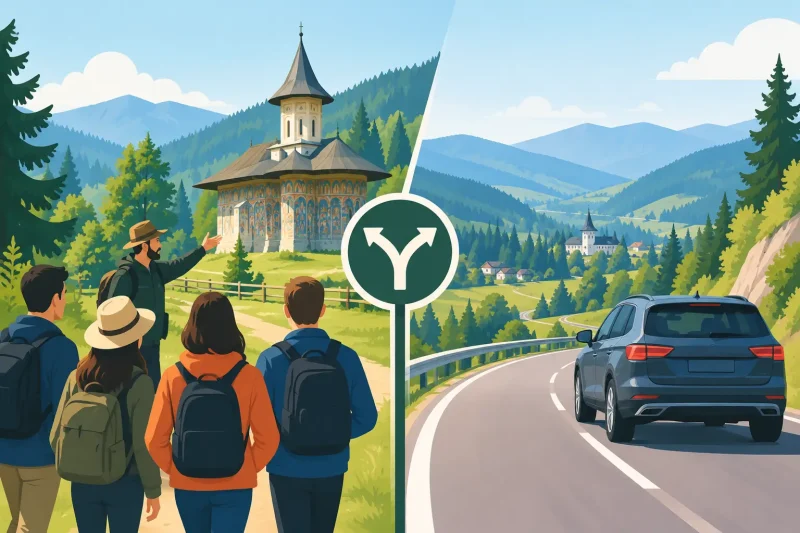
Bucovina is not a region best understood from a parking lot. At Voroneț, the famous blue façade is only the beginning. At Sucevița, the painted walls reward patience and context. Between monasteries, the landscape shifts from villages with carved wooden gates to forested passes and mountain views. That is why the question of guided versus self drive Bucovina travel is really a question about the kind of experience you want to bring home.
Both options can lead to remarkable days. A rental car gives independent travelers freedom to linger, change direction, and build a trip around their own rhythm. A guided tour adds local knowledge, comfortable transport, and the confidence that the day has been planned around real distances, opening times, and the stories that give each place meaning. The better choice depends on your available time, confidence behind the wheel, interests, and appetite for logistics.
What a Self-Drive Trip in Bucovina Does Well
Self-driving works well for travelers who enjoy planning and do not mind treating the road as part of the journey. Bucovina’s major monasteries are spread across a wide area, rather than gathered in one historic center. With a car, you can leave Suceava early, pause for photographs in the countryside, choose a village restaurant on impulse, or spend an unhurried afternoon near Câmpulung Moldovenesc.
It is also a good fit for a longer stay. If you have four or five days in the region, you can give each area its own pace: Voroneț and Humor on one day, Moldovița and Sucevița on another, then Putna, Dragomirna, or a mountain route toward Rarău. Families traveling with their own schedule may appreciate being able to stop whenever needed.
The independence is real, but so is the preparation. Driving times can look short on a map while local roads, village traffic, weather, and frequent stops make the day longer. The route between monasteries is scenic, yet it is not always intuitive for a first-time visitor. Parking is usually manageable, but finding the best approach, confirming visiting hours, and understanding local rules still take attention.
A self-drive itinerary is most satisfying when you are comfortable researching ahead of time, driving on unfamiliar roads, and accepting that not every detour will be efficient. It offers flexibility, not necessarily simplicity.
Where Self-Driving Can Limit the Experience
The main challenge is not finding the monasteries. It is understanding why each one matters.
The painted monasteries were created in different political, religious, and artistic moments. Voroneț is renowned for its intense exterior blue and dramatic Last Judgment scene. Humor has its own color palette and expressive narrative paintings. Moldovița combines grand architecture with depictions shaped by the anxieties and ambitions of medieval Moldavia — The Siege of Constantinople. At Sucevița, the monumental Ladder of Divine Ascent is far more compelling when someone can explain what you are seeing and how the images were meant to speak to their original audience.
Without interpretation, travelers can still admire the beauty. Yet the visit may become a sequence of attractive churches rather than a connected cultural journey through Orthodox faith, local patronage, defensive history, and artistic imagination.
There is also the practical matter of attention. A driver is responsible for navigation, road conditions, parking, fuel, and timing. On a full day with several stops, that can reduce the quiet, observant part of travel. If one person in your party does all the driving, that person may return with fewer photographs and less energy for the details inside each monastery.
Guided Versus Self Drive Bucovina: What Changes With a Guide
A guided day is not simply a car ride between landmarks. At its best, it turns the route into a story.
A local guide-driver can shape the order of visits around the day, explain the painted churches in accessible language, and connect the monasteries to the villages and landscapes around them. This is especially useful for first-time visitors to Romania, travelers with limited time, and anyone who wants a meaningful introduction without spending hours organizing it.
The practical advantages are equally valuable. You do not need to calculate whether Putna belongs on the same day as Sucevița, whether a mountain road makes sense in changing weather, or how much time to allow for a traditional lunch. Your transportation, route, and timing are coordinated in advance. Instead of watching navigation directions, you can watch the countryside unfold.
For couples and small private groups, a guide can also adapt the day. A visitor interested in photography may want more exterior time at dawn or late afternoon. A traveler focused on religious art may prefer fewer monasteries with deeper interpretation. Families may want a lighter pace, a museum visit, or a stop that breaks up the drive. Cultural enthusiasts can combine UNESCO sites with Pătrăuți, Arbore, Dragomirna, local museums, or an artisan encounter when available.
This flexibility matters because Bucovina is not a destination that should be rushed into a checklist.
The Trade-Offs of a Guided Tour
Guided travel costs more upfront than driving a rental car, particularly for solo travelers. That is the clearest trade-off. A private guide and vehicle reflect professional time, transport, fuel, route planning, and local expertise.
However, the comparison is not always as simple as rental price versus tour price. A self-drive day may also include the car, insurance, fuel, parking, meals during a longer route, and the value of time spent planning. For two, four, or more travelers, a private guided itinerary can become a practical choice as well as a cultural one.
The other consideration is independence. Some travelers prefer to decide at every intersection, spend an hour in a café without notice, or follow a road simply because it looks interesting. A good private tour can accommodate reasonable changes, but it still has a route and a shared purpose. If spontaneous wandering is your favorite part of travel, self-driving may feel more natural.
Group tours require a different calculation. They can be efficient and sociable, though the pace is usually set for the whole group. Travelers who value more time for questions, photography, or personal interests generally benefit from a private guide-driver arrangement.
Choose Self-Drive If This Sounds Like You
Self-driving is likely the right choice if you have several days in Bucovina, are comfortable driving abroad, enjoy researching historical sites, and like building your own rhythm. It is particularly appealing when your trip includes rural guesthouses, hiking in the Rarău Mountains, or time beyond the principal monastery circuit.
Give yourself room in the schedule. Rather than trying to visit every painted monastery in a single day, choose a coherent cluster and leave space for unexpected pauses. Weather changes quickly in the hills, and some of the most memorable moments happen between planned stops: smoke rising from a woodpile, hay fields in late summer, a roadside stand, or the sound of church bells across a village.
Choose a Guided Tour If This Sounds Like You
A guided tour is often the stronger option if Bucovina is one stop within a larger Romania itinerary, if you have one or two days available, or if the monasteries are the main reason you came. It suits travelers who want to hear the stories behind the frescoes, avoid navigation stress, and make the most of limited time.
It is also the better choice when comfort matters. Perhaps you are arriving from Bucharest, Cluj-Napoca, Iași, or another part of the country and want your Bucovina days to feel calm rather than operational. Perhaps you are traveling with parents, children, or friends who would rather share the view than negotiate routes. In those cases, having a local professional at the wheel changes the entire atmosphere of the day.
AXA Travel can arrange private and small-group experiences that pair the classic painted monasteries with the interests that make your trip personal, from mountain scenery and the Mocănița steam train to museums, traditional villages, and routes toward Northern Bukovina or Chernivtsi when conditions allow.
A Balanced Way to See Bucovina
You do not have to choose only one style for the whole trip. Many travelers find that one guided day gives them the cultural foundation they need, while a self-drive day afterward creates space to revisit a favorite area at leisure. After hearing the story of medieval Moldavia at several major monasteries, you may feel more confident stopping at a smaller church or taking the slow road through the countryside.
The right choice is the one that leaves you present enough to notice what Bucovina offers. Whether you hold the steering wheel or hand it to a local guide, leave time for a painted wall in changing light, a conversation over lunch, and the roads between the destinations. Those quieter moments are often where the region stays with you.