

Private Versus Group Bucovina Tours Compared
22/09/2026
Guided Versus Self Drive Bucovina: Which Fits?
27/09/2026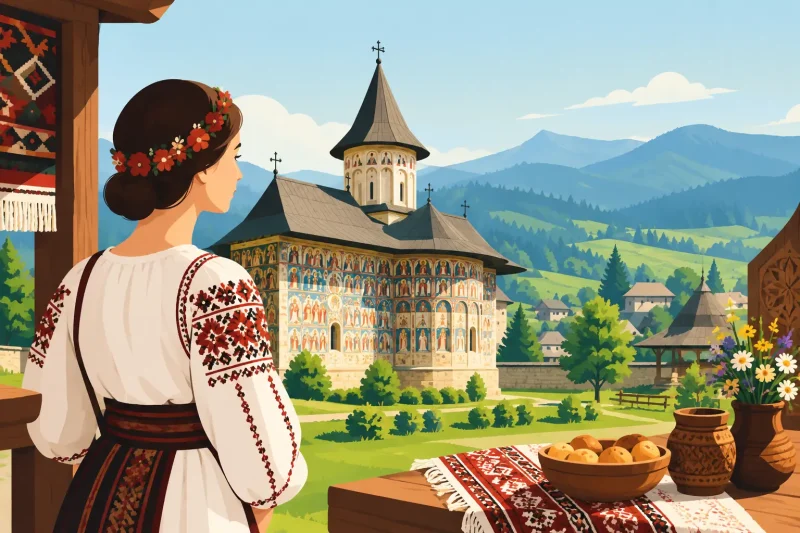
Bucovina is not a place to rush through with a checklist in hand. Its most memorable moments happen when a monastery wall reveals a story you had not noticed, when a village road leads to a wooden gate and a smoking chimney, or when the sound of a steam locomotive crosses a mountain valley. The best Bucovina cultural experiences bring together sacred art, rural traditions, local history, and the landscapes that have shaped life in northern Romania for centuries.
For travelers starting in Suceava, the region is rewarding precisely because its landmarks are spread across hills, villages, and mountain roads. A well-planned route turns travel time into part of the experience, allowing room for the stories behind each place rather than simply moving from one photo stop to the next.
1. See the Painted Monasteries in Their Natural Setting
The painted monasteries are the cultural heart of Bucovina. Their exterior frescoes, created mainly in the 15th and 16th centuries, are remarkable not only for their age but for their color, scale, and detail. Biblical scenes cover entire facades, turning church walls into visual narratives designed for communities that once learned religious history through images.
Voronet is often the first choice, known for its vivid blue background and the monumental Last Judgment scene on the western wall. It is deservedly famous, but it should not be visited in isolation. The experience becomes much richer when paired with other monasteries whose styles, settings, and stories differ.
Humor is smaller and intimate, with warm red-brown tones and a quiet village atmosphere. Moldovita stands in a wide valley, where its golden frescoes and fortified walls create a powerful sense of place. Sucevita combines richly preserved paintings with a larger defensive enclosure, while Arbore is admired for its elegant proportions and unusual green frescoes.
A full-day route can also include Patrauti, the oldest of the painted churches, whose compact form carries exceptional historical weight. These churches belong to the UNESCO-listed group of Churches of Moldavia, but the designation is only one part of their appeal. Standing in front of the frescoes, visitors see how faith, artistic ambition, and local craftsmanship shaped a distinct regional identity.
2. Visit Putna for History Beyond the Frescoes
Putna Monastery offers a different kind of cultural experience. Founded by Stephen the Great in the 15th century, it is closely associated with the medieval history of Moldavia and remains an important spiritual destination for Romanians. Stephen’s tomb draws visitors, but the wider complex invites a slower visit: the church, defensive walls, museum collections, and surrounding wooded hills all contribute to its atmosphere.
Putna works especially well on an itinerary with Sucevita, because the route connects two essential chapters of Bucovina’s heritage. Travelers interested in history often appreciate the contrast between Putna’s national significance and Sucevita’s intricate painted decoration.
3. Understand the Details With a Local Guide
The difference between seeing a monastery and understanding it can be substantial. Exterior paintings are filled with saints, symbols, historical references, and visual choices that are easy to miss without context. Why is blue so prominent at Voronet? What did the Ladder of Divine Ascent mean to a medieval community? Why were some walls painted more fully than others?
A licensed local guide can answer these questions while adapting the day to your interests. Art lovers may want more time for iconography and architecture. Families may prefer shorter visits balanced with scenic stops. Travelers with Romanian roots may be especially interested in the stories of monastic life, local customs, and the role these places still play in the community.
This approach is also practical. Many of Bucovina’s highlights are dispersed across rural roads, and distances can look deceptively short on a map. Private transportation with a guide-driver helps visitors spend their time at the sites rather than managing directions, parking, and changing plans.
4. Travel on the Mocanita Steam Train
A journey on the Mocanita steam train is one of Bucovina’s most atmospheric cultural outings. The historic narrow-gauge railway near Moldovita recalls the era when timber railways connected remote mountain areas with the wider region. The locomotive’s whistle, the slow movement through forested scenery, and the wood-and-metal carriages create an experience that feels wonderfully removed from a standard road trip.
It is not a museum visit in the conventional sense. It is a chance to understand the working landscapes of the Carpathians and the communities that developed around forestry, rail transport, and mountain life. Operating schedules can vary by season and day, so this experience is best planned in advance and combined with nearby monastery visits.
5. Make Time for Bucovina’s Village Crafts
Bucovina’s culture is still practiced in homes and workshops, not just displayed behind glass. Depending on the route and availability, visitors may encounter painted egg traditions, weaving, woodcarving, pottery, folk costume, and household crafts passed between generations.
A craft visit is most meaningful when it is treated as a conversation rather than a shopping stop. Ask about the motifs used on eggs or textiles, the time required to complete an object, and whether a particular pattern belongs to a local tradition. These details reveal how craft carries memory, faith, and family identity.
In the heart of Bukovina, at Vama, you will discover the most varied and extensive collection of painted and decorated eggs in Romania — also one of the most important in Europe.
Marginea, known for its distinctive black pottery, is a particularly worthwhile stop for travelers interested in ceramics. The dark, smoke-fired surfaces have a character unlike the brighter glazed pottery found elsewhere in Romania. In the right itinerary, a workshop visit can fit naturally between Sucevita and the mountain roads toward Moldovita.
6. Experience Rural Food and Hospitality
Bucovinian food is shaped by season, household traditions, and the practical demands of rural life. A local meal may include sour soups, sarmale, polenta, fresh cheese, smoked meats, mushroom dishes, and desserts made with fruit, poppy seeds, or sweet cheese. Recipes vary from one village to another, and that variation is part of the pleasure.
For many visitors, the most memorable meal is not necessarily the most elaborate one. It may be a simple lunch in a family-run guesthouse after a morning of monastery visits, served with local preserves and stories about the ingredients. Dietary needs can usually be accommodated with advance notice, although rural menus are often built around traditional dishes rather than extensive restaurant-style choices.
7. Add Dragomirna and Suceava’s Medieval Heritage
For travelers based in Suceava, Dragomirna Monastery offers a striking counterpoint to the painted churches. Its church is unusually tall and narrow, with a refined architectural silhouette and strong fortified walls. The setting feels peaceful, yet the complex also reflects the uncertainties of earlier centuries, when monasteries served spiritual, cultural, and defensive roles.
Suceava itself adds the historical framework for a Bucovina itinerary. As the former capital of medieval Moldavia, the city helps explain the political world in which Stephen the Great and later rulers built churches and monasteries across the region. A visit to the Suceava medieval fortress or nearby the Bucovina Village Museum can make the following days among the monasteries more meaningful.
8. Pair Culture With the Rarau Mountains
Bucovina should not be divided into „culture” on one day and „nature” on another as if the two were unrelated. The landscape is part of the region’s cultural story. Mountain pastures, forests, small settlements, and old road routes have shaped livelihoods, food, architecture, and local beliefs.
The Rarau Mountains are an excellent addition for travelers who want a scenic pause between cultural visits. The Lady’s Rocks -„Pietrele Doamnei rock” formations are among the area’s best-known views, and the drive itself can be spectacular in good weather. This option works best for visitors with extra time, especially in late spring through early fall. Weather, road conditions, and walking ability should guide the plan.
9. Consider a Day Trip to Cernauti
For a broader view of historical Bucovina, a day trip to Cernauti, now Chernivtsi in Ukraine, can be deeply rewarding. The city reflects the multicultural history of the former Habsburg province, with Romanian, Ukrainian, Jewish, German, Polish, and other influences visible in its architecture and urban character.
This is not a substitute for the rural monasteries of southern Bucovina. It is a complementary experience for travelers interested in regional history, architecture, and the shifting borders of Central and Eastern Europe. Because border procedures and travel conditions can change, this trip requires current planning and suitable documentation.
10. Choose an Itinerary That Leaves Room for Discovery
The best Bucovina cultural experiences are rarely improved by trying to see every monastery in a single day. A focused route of three or four sites allows time to look carefully, ask questions, enjoy a village meal, and notice the landscape between destinations. Two or three days make room for a more complete combination of painted monasteries, Vama painting eggs, Marginea pottery, the Mocanita steam train, Putna, Dragomirna and Carpathian mountain scenery.
For couples, families, and small private groups, a custom itinerary is often the most comfortable choice. AXA Travel can coordinate local guiding, transport, route timing, and cultural stops around the interests and pace of each group. Come with a short list of priorities, but leave space for the unplanned moments: a changing mountain view, a local conversation, or one more quiet minute in front of a painted wall.