
8 UNESCO Churches in Northern Romania to See
19/08/2026
The Judgement Day at Voronet, Sistine Chapel of the East
22/08/2026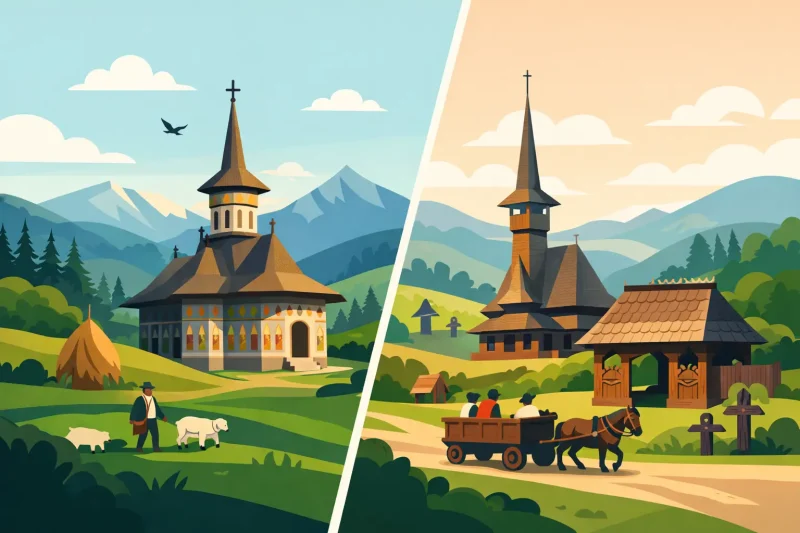
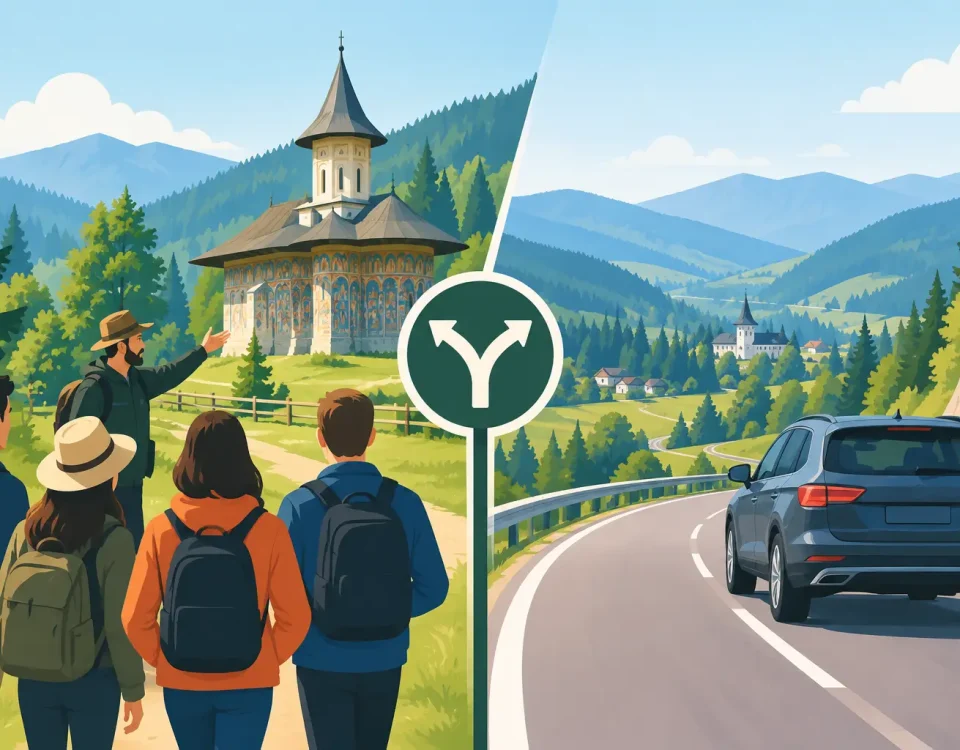
The question behind a Bucovina versus Maramures itinerary is not which region is more beautiful. Both are among northern Romania’s most memorable landscapes. The real choice is between two distinct ways of meeting Romanian heritage: Bucovina through painted monastery walls, medieval Moldavian history, and mountain valleys; Maramures through towering wooden churches, living village traditions, and a landscape shaped by timber, hayfields, and the old steam railway.
For travelers with limited time, choosing one region allows room for stories, local food, and unhurried visits. With four or more days, combining them creates a richly varied northern Romania journey, provided the route is planned around realistic driving times and seasonal road conditions.
Bucovina versus Maramures itinerary: the essential difference
Bucovina is the stronger choice for travelers drawn to art, architecture, and religious history. Its painted monasteries are not simply churches with decorative facades. Their exterior frescoes were created in the 15th and 16th centuries as visual narratives of biblical scenes, saints, judgment, faith, and power. Standing before the deep blue of Voroneț or the vivid walls of Moldovița, visitors see an artistic tradition that remains remarkably immediate.
Maramures feels more rooted in the rhythm of rural life. Its heritage is expressed in the tall wooden gates at village entrances, steep-roofed churches, hand-cut hay meadows, and craft traditions passed between generations. Here, the cultural experience is less concentrated in a group of major monuments and more woven into the road itself. A drive between villages can be as revealing as a museum visit.
Choose Bucovina if your priority is UNESCO heritage, frescoes, monasteries, and clear cultural routes from a Suceava base. Choose Maramures if you want wooden architecture, traditional villages, the Mocănița steam train, and a slower rural atmosphere. Travelers interested in both should resist treating either region as a quick stopover.
What a three-day Bucovina itinerary can include
The main advantage of Bucovina is that its main sights can be organized into logical one-day itineraries, especially with Suceava or Gura Humorului as a starting point. The monasteries are spread across valleys and hills, but a well-planned itinerary avoids unnecessary detours.
Day 1: Suceava’s historic surroundings
Start with the Suceava Citadel, and then in the immediate vicinity you will discover the old traditional houses of the Bucovina village museum. Then in a relaxing walk you can visit the Monastery of St. John the New – UNESCO and the Monastery of St. George – Mirauti, where you will discover the portrait of Emperor Franz Joseph of Austria. This first day is especially useful for travelers who arrive in Suceava in the morning and want a relaxing cultural start, rather than a long drive.
Day 2: Humor, Voroneț, Moldovița and Sucevița
This is the classic day of Bucovina’s monasteries, is standard tour offered by AxaTravel. Humor is intimate and expressive, with famous interior scene of Arhangels’s dance – Hora and a setting that still feels close to the village landscape. Voroneț is often the most well-known stop, admired for the deep blue background of its frescoes and the dramatic composition of the Last Judgment.
Moldovița adds a different scale and atmosphere, with its golden tones, fortified enclosure and detailed painted scenes. Sucevita is one of the most complete monastic complexes in the region, with extensive painted walls, defensive towers, and the famous Staircase of the Divine Ascent.
Depending on your pace, a stop in Marginea can introduce the area’s black pottery tradition.
Day 3: Dragomirna, Pătrăuți, Arbore and Putna
This is an extra day tour offered by Axa Travel, start with Dragomirna Monastery, known for its unusually tall proportions and tranquil fortified setting and continue to Pătrăuți, home to the oldest preserved painted church UNESCO in Romania.
Arbore is smaller and often quieter, but it rewards travelers who want to see just how varied Bucovina’s painted churches can be. This route is ideal for visitors who appreciate detail and want more than just a list of famous names. At each monastery, a guide can turn the colors, symbols, and dates into a connected story, rather than an isolated fact.
Putna Monastery carries a different emotional weight, being the final resting place of Stephen the Great, one of Moldavia’s defining rulers.
What makes a Maramures itinerary different
Maramures is best approached as a cultural landscape rather than a sequence of major attractions. The wooden churches are essential, but they make the most sense alongside village roads, local households, memorial sites, and the mountain setting.
A practical two or three-day route often begins around Vișeu de Sus or Borșa, then continues toward the historic villages of the Iza and Mara valleys before reaching Sighetu Marmației. The Mocănița steam train from Vișeu de Sus is a highlight for families and rail enthusiasts, but it requires advance planning because departures are scheduled and the experience takes a substantial part of the day.
The wooden churches of Ieud, Bârsana and Rozavlea show a different architectural language from Bucovina’s masonry monasteries. Their tall shingled roofs and narrow spires were built from local wood and shaped by centuries of craft knowledge. Bârsana Monastery, though more recent in its current form, is visually striking and offers a strong introduction to Maramures woodwork.
Sighetu Marmației adds historical depth through sites connected with the 20th century, while the nearby Merry Cemetery at Săpânța presents local memory in a colorful, surprising, and often humorous form. It is a worthwhile stop, but it should not define the whole region. Leave time for the smaller roads where wooden gates, orchards, and working farms reveal the everyday character of Maramures.
A six- or seven-day Bucovina and Maramures route
For many international visitors, the best answer to the Bucovina versus Maramures itinerary question is to combine both regions without rushing. A six-day private route gives enough time to understand their contrasts while keeping daily driving manageable.
Spend the first three days in Bucovina, using Suceava or Gura Humorului as a base. Include the main painted monasteries, plus at least one local craft stop, Vama – The painting eggs museum, a mountain experience hiking on the Rarău mountains – The ladie’s stones and a short trip by Mocanita-Moldovita steam train. This balance prevents the monastery visits from blending together and introduces the natural setting that shaped the region.
On day four, travel west toward Maramures. The exact transfer route depends on your accommodations, weather, and road conditions, particularly in colder months. This is a travel day, but it need not feel wasted. Stops in mountain towns, viewpoints, or villages can break up the drive and make the transition from Bucovina’s monastic valleys to Maramures’ timber landscape feel natural.
Use day five for the Mocănița steam train or a dedicated mountain-and-village day around Vișeu de Sus and Borșa. Do not schedule the steam train and a long cross-region transfer on the same day. The train journey deserves time, especially if you are traveling with children or want to enjoy the scenery without watching the clock.
On day six, explore the Iza Valley’s churches and villages, including Bârsana, Ieud and Rozavlea. Day seven can focus on Sighetu Marmației and Săpânța cemetery, or remain flexible for a slower morning in the countryside before continuing to your next destination. If you have only six days, reduce the number of stops rather than shortening every visit.
Transport, timing, and the value of local planning
Northern Romania rewards travelers who plan their trip with geography in mind. Distances may seem modest on a map, but mountain roads, village traffic, photo stops, and monastery opening times all influence the day. Self-driving is possible, but it requires one person in the group to navigate unfamiliar roads while everyone else misses out on the local landscape and context.
A private guide-driver is especially useful when combining Bucovina and Maramures. It allows the itinerary to adapt to weather, a preferred lunch stop, a monastery service, or a family’s pace. It also creates space for the details that rarely appear in a standard route: why a painted wall faces a certain direction, how a wooden gate signals a household’s identity, or where to find a traditional craft workshop.
Late spring through early fall offers the easiest conditions for a combined trip. Summer brings green hills, village activity, and longer daylight, although popular sites can be busier. Autumn is beautiful for color and harvest traditions. Winter has a special atmosphere, but snow and mountain roads can require a more conservative schedule.
Make the choice based on your travel style
Bucovina is more concentrated, more art-focused, and easier to experience well over a short stay. Maramures is more dispersed, more rural, and best for travelers willing to slow down. Neither region should be judged by the number of places visited in a day.
If the blue walls of Voroneț and the history of medieval Moldavia are what brought you to northern Romania, give Bucovina the time it deserves. If you are drawn to wooden spires, traditional gates, and the feeling of a countryside still shaped by old skills, continue into Maramures. The most rewarding itinerary leaves room for the unplanned moment: a church bell across a valley, fresh bread at a village table, or a mountain road that makes everyone ask the driver to stop for one more photograph.
Every moment matters
For those with limited time, AXA Travel can offer a private itinerary in northern Romania, based on your interests, a focused two-day tour where you can visit both regions… one day tour to Bucovina with its UNESCO painted monasteries and one day tour in Maramures with its UNESCO wooden churches, combined with the mountainous landscapes of the Carpathian.