

A Bucovina Monasteries Tour Worth Your Day
17/08/2026
Bucovina Versus Maramures Itinerary: Which One?
20/08/2026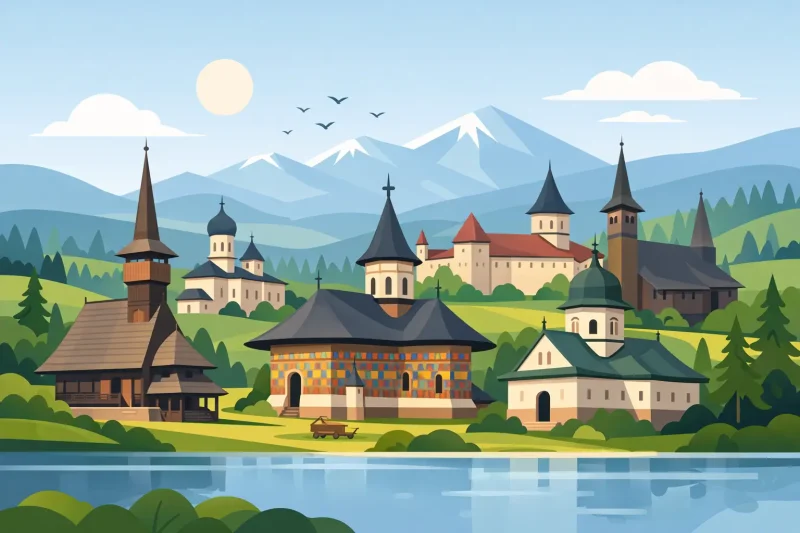
A wall of intense blue opens above the monastery of Voroneț, filled with angels, saints, and scenes of the Last Judgment. It is the image many travelers expect from the UNESCO churches of Northern Romania, but it is only one chapter in a remarkable cultural landscape. The eight UNESCO-listed churches of Moldavia are spread across Bucovina and Suceava County, each with its own color palette, stories, architecture, and pace.
These are not grand urban cathedrals designed to impress from a distance. Most stand in active monasteries beside of quiet village settings, where painted walls, wooden gates, gardens, and mountain roads shape the experience. A well-planned visit gives each church to speak for itself.
Why the UNESCO churches of northern Romania matter
The churches were built mainly during the 15th and 16th centuries, when the medieval Principality of Moldavia stood at the meeting point of powerful neighboring worlds, like Otoman empire to south, Russian empire to east, Polish empire to north and Hungarian empire to west. Their exterior frescoes are their defining feature. Instead of limiting religious painting to the interior, Moldavian craftsmen turned whole façades into visual narratives: biblical scenes, saints, hymns, moral lessons, and local historical references.
For communities that once had limited access to written texts, these images were a form of public teaching. For visitors today, they are also an miracol of extraordinary survival. Rain, snow, sun, invasions of otomans, tartars, cossacks and centuries of administrative and political change have touched these walls, but yet much of their color and detail remains visible.
The UNESCO designation covers eight churches, not every famous monastery in Bucovina. Putna and Dragomirna, for example, are deeply worthwhile stops on a broader route, but they are not part of this specific UNESCO group. Knowing the distinction helps travelers plan realistically and appreciate what makes each place special.
The eight UNESCO painted churches
Voroneț Monastery
Voroneț is the best-known stop, celebrated for the deep of Lapis lazuli (Lazurit) tone often called Voroneț blue. Its western wall presents a vast Last Judgment scene, with a dramatic composition that can be read in layers. Founded in 1488 by Stephen the Great, the church is compact, but the paintings give it enormous visual force. It is especially rewarding in the morning visiting, before larger visitor groups arrive.
Humor Monastery
Humor has a warmer, more intimate character. The brown and red toned frescoes and the scene known as the Hora of the Archangels – a traditional popular Romanian dance, make it an essential complement to Voroneț. Built in 1530, the church has no tower, which gives its silhouette a distinctive, low profile. The surrounding village landscape also makes Humor a pleasant place to slow down rather than simply photograph and leave.
Moldovița Monastery
Nestled among rolling hills, Moldovita combines strong exterior colors with the interior of a fortified monastery. The golden yellow and vivid red are particularly striking in natural light. The Siege of Constantinople is the defining scene that conveys the message that… the power of faith can change the course of history. Moldovita combines naturally with a drive through mountain villages or an additional stop at a local craft workshop.
Sucevița Monastery
Sucevița is often the church visitors remember for its scale and green-dominant frescoes. Its exterior scene of the Ladder of Divine Ascent is one of the most compelling images in the entire group, showing souls climbing toward heaven while demons try to pull them away. The fortified walls, towers, and broad courtyard create a setting that feels both devotional and defensive.
Arbore Church
Arbore is quieter and more modest in size, which is precisely part of its appeal. Built in 1503 by the nobleman Luca Arbore, it is recognized for its finely composed frescoes, including the hymn to the Virgin. The church is not located within a large monastic complex, so it offers a different perspective on the tradition: painted architecture rooted in a rural community.
Pătrăuți Church
Pătrăuți is the oldest church in the UNESCO group, founded in 1487 by Stephen the Great. Its compact form and peaceful setting make it easy to overlook on a rushed itinerary, but its frescoes deserve careful attention. The Cavalcade of the Holy Cross is especially important, combining religious symbolism with the concerns of a medieval frontier region.
Probota Monastery
Probota, near Dolhasca, is one of the more logistically separate UNESCO sites, so it is often best included on a dedicated eastern route rather than squeezed into a single day with the other painted monasteries. Founded in 1530, it has a strong fortified presence and exceptional frescoes. Travelers interested in the evolution of Moldavian monastic architecture will find it particularly rewarding.
St. John the New Church in Suceava
Unlike the rural monasteries, St. John the New Church is in Suceava, the historic capital of medieval Moldavia. Built in the early 16th century, it remains an active spiritual landmark and contains the relics of St. John the New. This stop works well at the beginning or end of a Bucovina itinerary, especially for travelers staying in Suceava and wanting historical context before heading into the countryside.
Building a practical painted churches route
The eight sights cannot be adequately visited in a single, rushed day. The western group – Voroneț, Humor, Moldovița, Sucevița and Arbore – can form the center of a full-day or two-day itinerary from Suceava, depending on your interests and preferred pace. Pătrăuți and Sfântul Ioan cel Nou fit naturally into the vicinity of Suceava, while Probota requires more driving and is best treated as a separate extension.
A private route has a clear advantage here. The distances may seem short on a map, but local roads, village traffic, photo stops, lunch breaks and monastery schedules all affect the day. A driver-guide can adjust the order depending on the weather, operating conditions and the time you want to spend at each location. This is most important in the summer, when popular sights can get crowded towards the end of the morning.
For a first visit, allow two days. One day can focus on Voroneț, Humor, Moldovita and Sucevița, with time for lunch in a local setting and scenic stops along the way. Axa Travel offer this trip call Bucovina painted monasteries tour. A second day can include Arbore, Pătrăuți, Putna and Dragomirna, offered by Axa Travel as Bucovina extra day tour. Trips of three or more days can combine painted churches with the Rarău Mountains and Mocanita steam train.
What to notice beyond the famous frescoes
The paintings are the headline, but the experience becomes richer when you look at the churches as complete places. Notice the roof lines, often dramatically steep to withstand heavy snow; the stone and wooden details around entrances; the defensive walls at monasteries such as Sucevița and Moldovița; and the changing relationship between a church and its surrounding village.
Inside, the atmosphere is usually quieter and darker than outside. Frescoes continue across vaults and walls, while candlelight, icons, and the scent of incense remind visitors that these are living religious spaces, not museum rooms. Dress modestly, keep voices low, and ask before taking photographs indoors. Rules can differ from one site to another, and worship always takes priority over tourism.
The best season depends on what you value. Late spring and early fall bring comfortable temperatures and softer colors in the landscape. Summer offers long days and lively villages, but also more visitors. Winter can be beautiful and deeply atmospheric, though road conditions and daylight require a more flexible plan.
Travel with context, not just a checklist
It is possible to visit the painted churches independently, especially with a rental car and extra time. Yet the challenge is not only finding the roads. It is understanding why one blue wall matters, how a siege scene became a religious message, or why an apparently small church such as Pătrăuți belongs among Europe’s most important medieval monuments.
A locally organised journey also makes space for the details that standard routes often miss: a traditional meal between visits, a viewpoint above a valley, a craft demonstration, or a conversation about local customs. AXA Travel builds private and small-group Bucovina itineraries around that kind of connection, with licensed local guidance and transport arranged from Suceava.
Give the churches time, and resist the temptation to collect them as eight quick stops. Sit for a few minutes in a monastery courtyard, watch the changing light on a painted wall, and let the landscape explain why this corner of Romania has preserved such a distinctive spiritual and artistic world.