
8 UNESCO Churches in Northern Romania to See
19/08/2026
The blue of Voroneț is not a detail you notice from a distance. It arrives all at once, covering an exterior wall with saints, angels, and the Last Judgment beneath the changing light of the Bucovina hills. A Bucovina monasteries tour is the best way to understand why these small Orthodox foundations are among Romania’s most remarkable cultural treasures – and why a visit is about more than collecting UNESCO sites.
From Suceava, the painted monasteries are within reach of a rewarding full day. Yet the roads wind through villages, the stories span five centuries, and every monastery has its own character. A well-paced private tour turns the journey into a coherent experience: medieval Moldavia, living monastic life, rural landscapes, traditional crafts, and a good local meal between visits.
Why the painted monasteries deserve time
The monasteries of Bucovina were built in the late 15th and 16th centuries, during a period when the Principality of Moldavia stood between powerful neighbors and defended both its territory and its faith. Their churches are modest in scale compared with great European cathedrals. Their power is on the outside.
Walls became painted books. Biblical scenes, saints, parables, and visions of judgment were created in strong mineral colors so that local communities could read sacred history in images. The frescoes were not intended as decoration alone. They taught, commemorated, and connected village life with a wider Orthodox world.
Several of these churches form part of the UNESCO-listed Churches of Moldavia. Voroneț, Humor, Moldovița, and Sucevița are the essential quartet for many visitors. Seeing all four in one day is possible from Suceava or Gura Humorului, but it should not become a race. The value lies in stopping long enough to look closely, ask questions, and notice how each place sits within its landscape.
A practical Bucovina monasteries tour itinerary
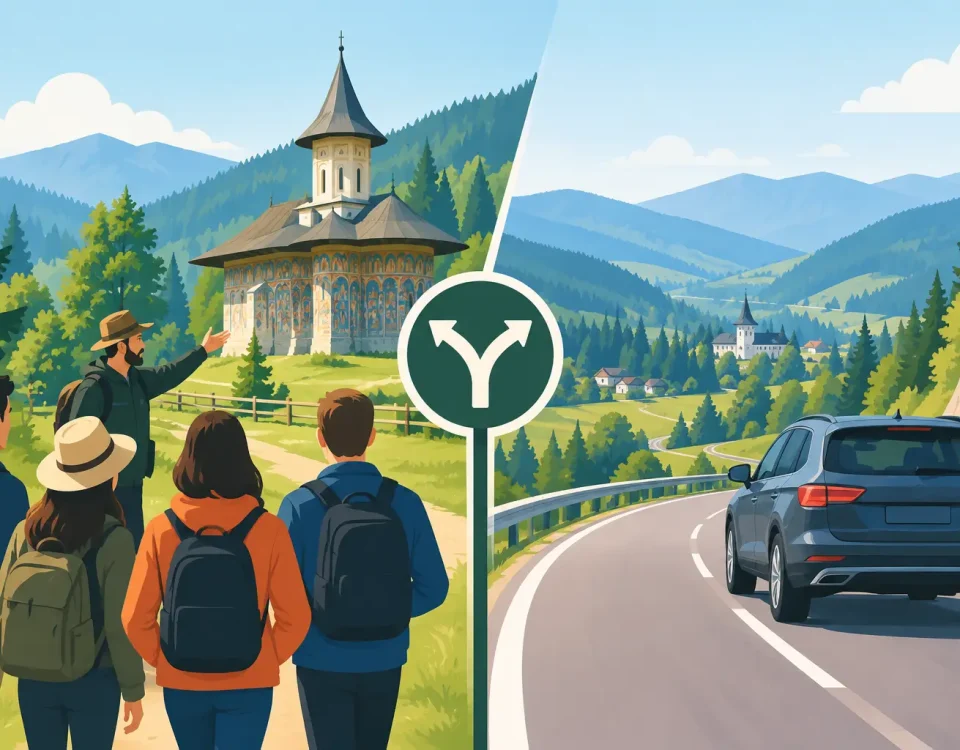
A typical day begins with pickup in Suceava. Starting early makes a real difference, especially in summer, when the monastery courtyards become busier and daylight is best for viewing the exterior paintings. Travel by private car or minibus also leaves room for unplanned pauses: a hayfield, a roadside market, a wooden gate, or a view toward the Obcina mountains.
The route can be adjusted around your interests, but these four stops create a strong first introduction to Bucovina.
- Voroneț Monastery is known around the world for its intense blue frescoes. Look beyond the color to the western wall, where the Last Judgment is painted with extraordinary movement and detail. The church was founded by Stephen the Great in 1488, and its sheltered courtyard often feels contemplative even when visitors are present.
- Humor Monastery has a warmer visual language, with red tones and expressive narrative scenes. Founded in 1530, it is especially appreciated by travelers who enjoy the human detail in the frescoes: faces, gestures, musicians, and everyday visual references woven into religious imagery.
- Moldovița Monastery stands in a broad valley near the village of Vatra Moldoviței. Its exterior paintings include the famous Siege of Constantinople, a complex image that brings theology, history, and political symbolism together. The fortified enclosure and surrounding countryside add to the sense of arrival.
- Sucevița Monastery is often the final highlight because of its scale and exceptional state of preservation. Its green frescoes and fortified walls give it a different atmosphere from the earlier monasteries. The Ladder of Divine Ascent, painted on the northern wall, is one of the most memorable images in the region.
Between these stops, a local guide gives context that is easy to miss when traveling independently. Why does one monastery favor blue while another favors red? What did the Ottoman frontier mean for Moldavia? Why are church porches open, and why do some paintings survive better on one wall than another? These are the details that make the route feel less like a checklist and more like a journey back in time.
Add a village experience, not another rushed stop
The distance between monasteries is part of the experience. Bucovina remains a region where carved wooden houses, haystacks, roadside shrines, and working farms are part of the landscape rather than staged attractions. A tour has more depth when it includes one meaningful local encounter instead of squeezing in every possible monument.
Depending on the route and season, that could mean a traditional egg-painting workshop in Moldovița, where the wax-resist technique creates the intricate patterns seen on Bucovinian Easter eggs. It could be a visit to a pottery workshop, a short walk through a village, or lunch at a rural guesthouse serving dishes such as ciorbă, sarmale, trout, polenta, and local cheese.
This is also where a private itinerary has an advantage. Some travelers want the religious and artistic history in greater detail. Others would rather balance the churches with food, crafts, and mountain scenery. Families may prefer a shorter monastery visit followed by a hands-on workshop. Couples often enjoy a slower route with time for photographs and a relaxed lunch. There is no single correct version of the day.
What to know before you go
The painted monasteries are active religious places, not open-air museums. Modest clothing is appropriate: shoulders and knees should be covered, and women may wish to carry a scarf for use where requested. Keep voices low inside the churches and in courtyards where services or prayer may be taking place.
Photography rules vary. Exterior photography is generally one of the pleasures of the visit, but interiors may have restrictions or require an additional fee. Your guide can help clarify the current practice at each monastery. Flash photography should never be used around historic frescoes.
Spring through fall offers the easiest conditions for a full-day route. May and June bring fresh green hillsides, while September and October can offer clear light and autumn color. Summer is lively and warm, with more visitors at Voroneț. Winter visits are quieter and beautiful, but daylight is shorter, roads can be affected by snow, and a more selective itinerary may be wiser.
A full circuit of Voroneț, Humor, Moldovița, and Sucevița normally requires a full day once driving, visits, lunch, and short stops are included. If you have limited time, choose two or three monasteries rather than trying to see four too quickly. Voroneț and Humor work well for a shorter outing from Suceava or Gura Humorului. Moldovița and Sucevița reward travelers who can give the western part of Bucovina more time.
Why local transport and guiding matter here
Driving in Bucovina is not difficult for an experienced visitor, but self-driving changes the rhythm of the day. Navigation, parking, entrance arrangements, changing opening conditions, and the temptation to hurry all take attention away from the places themselves. Public transport can connect some towns, but it is not designed for an efficient monastery circuit.
With a driver-guide, the route begins at your accommodation or airport transfer point in Suceava and follows the pace that suits your group. You can spend longer at a fresco that interests you, stop for a village lunch without worrying about the return drive, or add an optional experience when time allows. For small groups, this is often more comfortable than joining a large coach excursion and more informative than relying on guidebook captions.
AXA Travel builds private Bucovina days around this local rhythm, combining transport, guiding, and realistic timing from Suceava or Gura Humorului. The goal is not to fill every hour. It is to make sure the monasteries, roads, and villages belong to the same story.
When you leave Sucevița or Voroneț in the late afternoon, look back once before getting into the car. The painted walls do not need much explanation in that moment. Against the green hills and village roofs, they still do what they were created to do: hold history, faith, and color in plain sight.