
6 Best Suceava Day Trips for Bucovina Travelers
14/09/2026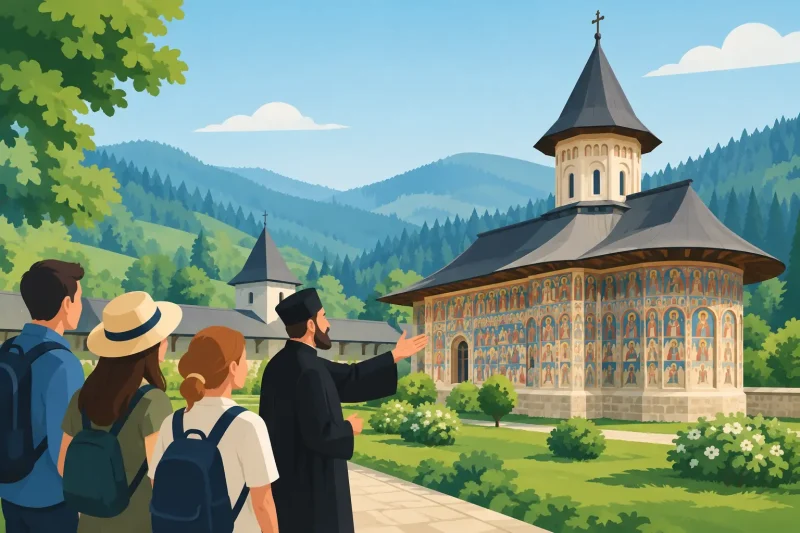
A painted church can look quiet from the road: white walls, a steep shingled roof, a village lane framed by orchards. Step closer, however, and the exterior becomes a complete visual narrative. Saints, angels, hymns, battles, and scenes of judgment cover the walls in colors that have endured for centuries. Guided monastery tours turn that first impression into a meaningful encounter with Bucovina’s history, faith, and living rural culture.
For many visitors, the question is not whether to see the painted monasteries, but how to see them without rushing. They are spread across northern Romania, often separated by scenic country roads, mountain foothills, and villages where the journey itself is part of the experience. A local guide-driver brings the route together, leaving you free to look out the window, ask questions, and spend your attention where it belongs: inside the story of each place.
Why choose guided monastery tours in Bucovina?
The monasteries of Bucovina are not a single museum complex with one entrance and one prescribed route. Each has its own setting, artistic character, and history. Voronet is famous for its intense blue and dramatic Last Judgment fresco. Humor feels intimate and richly detailed, while Moldovita opens onto a broad landscape and reveals scenes of the Siege of Constantinople. Sucevita stands out for its scale, fortified walls, and the famous Ladder of Divine Ascent.
Without context, these churches are beautiful. With context, details that might seem decorative begin to speak. A guide can explain why medieval Moldavian rulers commissioned painted exteriors, how Orthodox theology was made visible for communities, and why certain colors and scenes were chosen. You also gain a clearer view of the region’s position between mountain routes, political frontiers, and strong local traditions.
The practical benefit matters just as much. Driving between monasteries, locating entrances, understanding visiting etiquette, and fitting lunch or a workshop into the day can take more planning than travelers expect. Guided travel replaces that logistical effort with a well-paced day. It is especially useful for couples, families, and small groups who want flexibility without renting a car or following a large coach schedule.
The painted monasteries worth building a route around
A first visit often works best as a full-day circuit from Suceava or Gura Humorului. The exact sequence depends on your starting point, season, opening conditions, and how much time you want to spend at each stop. These are the landmarks that shape many guided monastery tours:
- Voronet Monastery is among Romania’s most recognized religious monuments. Its deep blue frescoes and vivid west-wall Last Judgment make it an essential stop for first-time visitors.
- Humor Monastery is known for warm red tones, expressive frescoes, and a peaceful setting near Gura Humorului. It is a rewarding place to slow down and notice small narrative details.
- Moldovita Monastery combines monumental exterior painting with a rural landscape that feels distinctly Bucovinian. Its historic defenses and carefully preserved church give the visit added dimension.
- Sucevita Monastery pairs painted walls with a strong fortified enclosure. The green tones and complex Ladder of Divine Ascent scene are especially memorable.
- Arbore Monastery is smaller in scale but artistically important, with frescoes that show a different rhythm and color palette from the better-known sites.
- Putna Monastery is a major spiritual and historical destination, closely associated with Stephen the Great. Although it is not one of the painted UNESCO churches, it belongs naturally in a deeper Bucovina itinerary.
Several of Bucovina’s painted churches are part of the UNESCO World Heritage listing, including Voronet, Humor, Moldovita, Sucevita, Arbore, and Patrauti. A knowledgeable itinerary can also include less-visited sites such as Dragomirna, known for its elegant proportions and high defensive walls, or Patrauti, whose small church holds remarkable early frescoes.
A good itinerary is about rhythm, not just distance
It is tempting to count monasteries and try to fit as many as possible into one day. Yet six stops can become a blur if there is no time to absorb what makes each one distinct. For most travelers, three or four major sites create a satisfying day, especially if the route includes a proper lunch, photo stops, and time to browse local crafts.
A private tour offers the greatest freedom. Art lovers may prefer more time at Voronet and Sucevita, with close attention to iconography and restoration. Families may enjoy pairing two monasteries with an easy countryside stop or a local museum. Travelers with several days can spread the experience across a slower itinerary and add Putna, Dragomirna, Marginea black pottery, or a mountain drive through the Rarau area.
Season also changes the experience. Spring brings fresh green hillsides and quieter roads. Summer has long daylight hours and lively village activity, but popular sites can be busier. Autumn gives the region its richest colors and a contemplative atmosphere. Winter can be beautiful and peaceful, although snow and shorter days call for a carefully planned route.
What a local guide adds beyond transportation
The best guided experience does not feel like a lecture delivered from a script. It feels like traveling with someone who understands the region and can adapt the day to your interests. A local guide may point out the difference between a monastery, a convent, and a parish church, explain the symbols in a fresco, or share how religious life continues at an active monastic community.
That local perspective also helps travelers approach sacred places respectfully. Modest clothing is appropriate, and women may be asked to cover their heads at certain sites. Silence is appreciated around services and prayer areas. Photography policies vary, particularly indoors, so it is best to follow instructions at each monastery rather than assume that the same rule applies everywhere.
There are trade-offs to consider. Group tours can be a good value and a pleasant way to meet other travelers, but they follow a fixed timetable. A private guided tour costs more, yet it can accommodate a hotel pickup, a preferred pace, mobility needs, a longer lunch, or an interest in specific monasteries.
Pair monasteries with the wider Bucovina experience
The painted monasteries tell only one part of Bucovina’s story. Their setting is inseparable from the region’s forests, farms, craft traditions, and borderland history. A well-designed cultural day can include a stop at a pottery workshop in Marginea, where the distinctive black ceramics are made using techniques passed down through generations. Another route might combine churches with the Bucovina Village Museum in Suceava or a scenic drive toward the Rarau Mountains.
For travelers staying longer, the options become even broader. The Mocanita steam train offers a different view of northern Romania’s landscapes, while a trip toward Chernivtsi in Ukraine introduces the historical links of the wider Bukovina region. These additions should not be treated as distractions from the monasteries. They provide the human and geographic context that makes the religious heritage more vivid.
AXA Travel can organise monastery-focused day trips and custom multi-day routes with local licensed guide-drivers and comfortable transportation. The right program can be built around a first introduction to the UNESCO churches, a photography-centered route, a family schedule, or a more specialized interest in Orthodox art and Moldavian history.
When you stand before a painted wall in Bucovina, give yourself more than a quick photo stop. Leave room for the guide’s story, the sound of the village, and the details you notice only after looking twice. That unhurried attention is often what travelers remember most.