
Painted Monasteries of Bucovina: Christianity in Frescoes
31/08/2026
Suceava Private Driver Guide for Bucovina
02/09/2026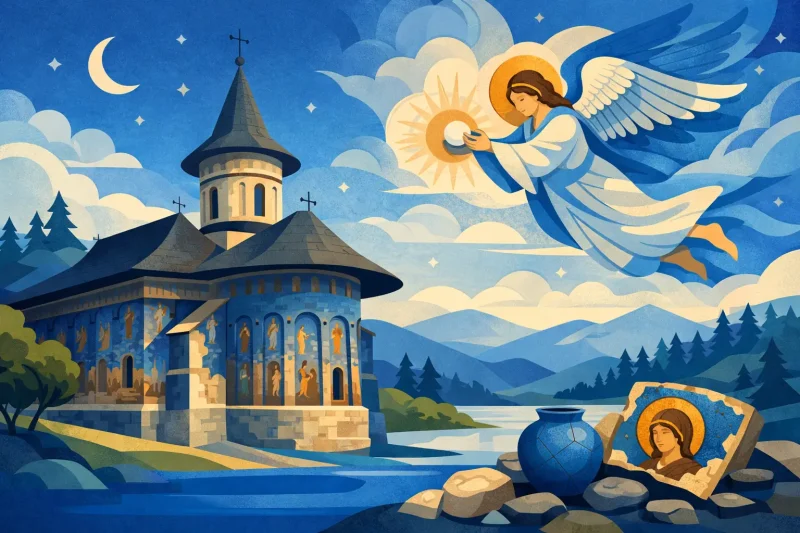
Stand in the courtyard of Voronet Monastery and the first color that holds your attention is not gold, red, or green. It is a deep, luminous blue spread across scenes of saints, angels, prophets, and the Last Judgment. The blue of Voronet has become one of Bucovina’s most recognizable cultural symbols, admired not only for its beauty but also for the way it has endured on an exterior church wall for centuries.
For many visitors, it is the image that brings them to northern Romania. Yet its real power becomes clear only when you see it where it belongs: beneath the eaves of a small monastery church, framed by forested hills and surrounded by a living Orthodox community.
Why the Blue of Voronet Is So Famous
Voronet Monastery was founded in 1488 by Stephen the Great, one of medieval Moldavia’s most important rulers. The church was built quickly, according to tradition in just a few months, as an act of faith and thanksgiving after a military victory. Its interior was painted in the late 15th century, while the remarkable exterior frescoes that visitors know today were added in 1547, during the time of Metropolitan Grigorie Rosca.
The painters transformed the outside walls into a vast visual narrative. At a time when religious teaching was often communicated through images, these frescoes presented biblical history, doctrine, and moral lessons in a language accessible to every visitor. The western wall is especially celebrated for its monumental Last Judgment, where heaven, hell, apostles, angels, kings, and ordinary human figures appear in an intricate and deeply moving composition.
The blue background gives this entire world extraordinary depth. Rather than feeling flat or decorative, the color creates a sense of open sky behind the figures. In changing daylight, it can appear intense and cool, soft and silvery, or almost violet. This is one reason photographs rarely capture the full experience.
A pigment, a technique, and a protected setting
The exact durability of Voronet blue has inspired countless stories. It is often described as a mystery, but its survival is better understood as the result of several elements working together: mineral-based pigments, skilled fresco technique, carefully prepared plaster, the shelter provided by the church’s wide roof, and generations of care.
The blue is generally associated with azurite, a mineral pigment used in historic painting. But no single ingredient explains what visitors see today. The painters had to apply colors at the right moment onto fresh lime plaster, creating a bond between pigment and wall. They also understood how to organize a composition for the outdoors, balancing strong colors with lines, faces, and architectural details that remain readable from a distance.
Time has still left its mark. Some sections are more weathered than others, and the colors are not identical across every wall. That is not a disappointment. It is part of the monument’s truth. Voronet is not a replica preserved behind glass. It is a five-century-old church that has lived through seasons, political change, restoration, worship, and continuous public admiration.
Reading the Painted Walls at Voronet
A visit becomes richer when you look beyond the famous shade. The exterior frescoes are not simply paintings placed around a building. They are arranged with intention, responding to the direction of the walls and to the visitor’s movement around the church.
On the west facade, the Last Judgment commands attention. Christ appears at the center of the heavenly order, while the composition unfolds in multiple directions. The scene is large, detailed, and surprisingly human. It presents divine judgment, but it also includes musicians, rulers, clerics, and people from different parts of the known world. The painted river of fire and the orderly ranks of the saved and condemned create a powerful contrast between solemnity and visual energy.
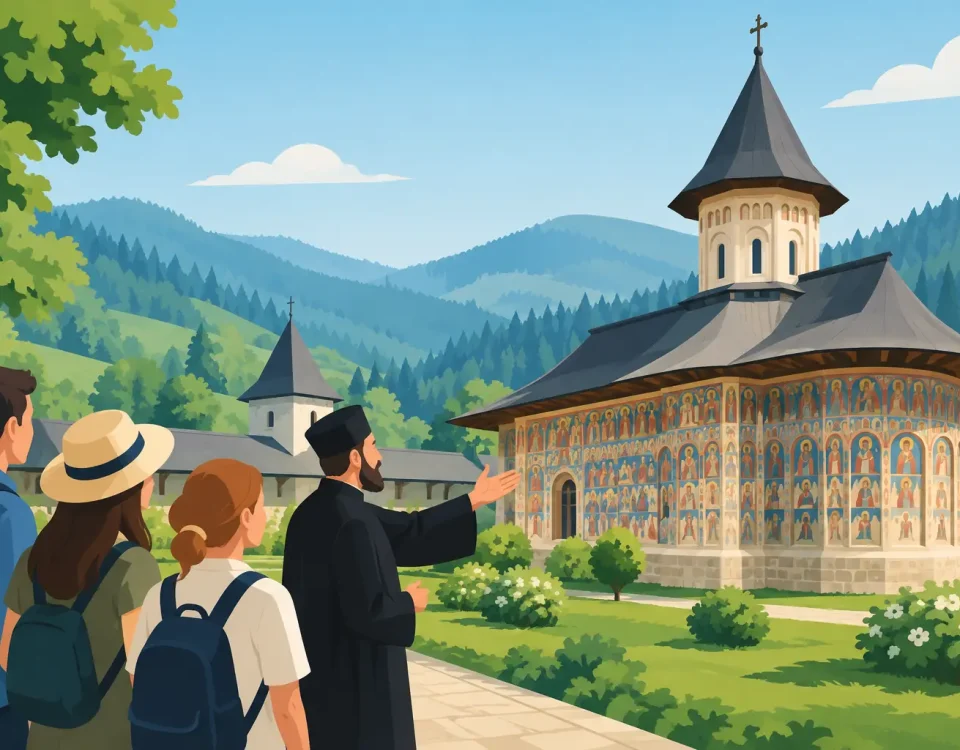
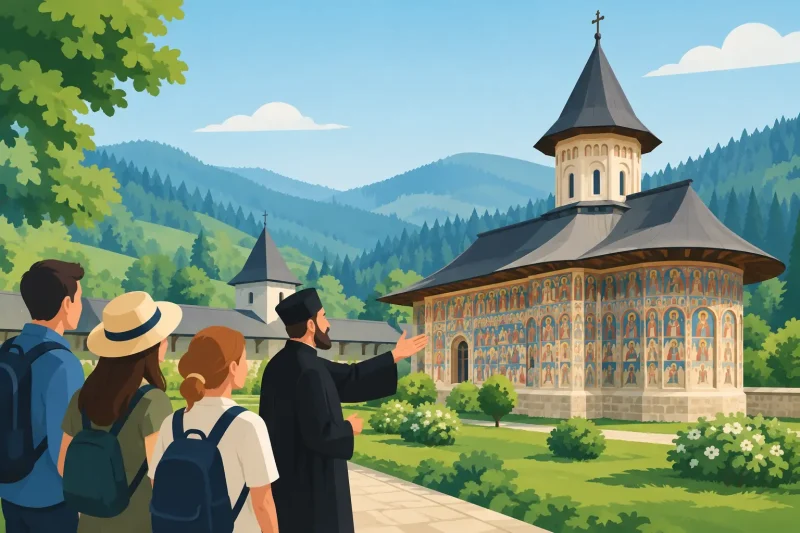
Elsewhere, visitors find the Tree of Jesse, processions of saints, hymns to the Virgin Mary, and scenes that connect Scripture to the theological life of the Orthodox Church. A local guide can help distinguish the principal narratives from the smaller details, which are easy to miss on a first visit. The paintings reward patience. Step back to understand the full composition, then move closer to notice faces, garments, instruments, and inscriptions.
More than a “Sistine Chapel of the East”
Voronet is often called the “Sistine Chapel of the East.” The comparison communicates the artistic importance of the site, but it can also oversimplify it. Voronet is not valuable because it resembles a Western European landmark. It is exceptional because it belongs to the distinctive artistic world of medieval Moldavia.
The painted monasteries of Bucovina combine Byzantine religious tradition, local craftsmanship, Moldavian architecture, and a visual language shaped by this borderland region. Voronet is part of a wider group that includes Humor, Moldovita, Sucevita, Arbore, Patrauti, and other remarkable monastic sites. Together, several of these churches are recognized as UNESCO World Heritage monuments.
Seeing Voronet alone is memorable. Seeing it alongside other painted monasteries gives the blue its proper context. At Humor, visitors encounter a warmer palette and lively narrative scenes. Moldovita is known for its elaborate Siege of Constantinople. Sucevita offers a different scale and the famous Ladder of Divine Ascent. Each monastery has its own personality, and each makes the artistic choices at Voronet easier to appreciate.
How to Plan a Meaningful Visit
Voronet Monastery is near the town of Gura Humorului, in southern Bucovina. It is accessible on a day trip from Suceava, but the region’s monuments are spread across valleys and small towns, so travel time matters. A rushed stop can show you the color; a well-planned route lets you understand the place.
Morning is often an excellent time to visit, particularly in the warmer months, when the courtyard is quieter and the light can be gentler on the painted walls. Weather changes the experience. On a bright day, the blue can look crisp and brilliant. Under clouds, it may appear deeper and more contemplative. Both are beautiful, and neither is more authentic than the other.
Dress respectfully, as Voronet remains an active religious site. Modest clothing is appropriate, and visitors should follow any guidance provided at the entrance. Photography rules can vary, especially inside churches, so it is best to ask before taking pictures. A quiet approach also helps preserve the atmosphere for worshippers and for other travelers.
For travelers with limited time, Voronet can be paired naturally with Humor Monastery and the town of Gura Humorului. Those who want a fuller cultural day can continue toward Moldovita or Sucevita, depending on the route and pace. A multi-day itinerary opens more possibilities: Putna Monastery, the ceramics traditions of Marginea, local museums, rural meals, and the mountain landscapes around Rarau.
Private transportation is particularly useful in Bucovina because the monasteries are not clustered within one walkable town. It gives couples, families, and small groups the freedom to spend longer at the places that interest them most, stop for a village view or traditional craft workshop, and avoid planning around limited connections. With a local licensed guide-driver, the road between monuments becomes part of the story rather than empty time between stops.
What the Color Represents for Bucovina
The blue of Voronet has become a shorthand for Bucovina, appearing in travel conversations, art books, and the memories visitors carry home. But its meaning is larger than a striking pigment. It represents a region where faith, artistry, and landscape have remained closely connected.
This is why Voronet appeals to very different travelers. Architecture lovers see a sophisticated medieval monument. Art enthusiasts study technique and composition. Families find a vivid way into history. Spiritual travelers encounter an active place of prayer. For many international guests, it is also an introduction to a side of Romania that feels unexpected: refined, rural, deeply historic, and still personal.
AXA Travel designs Bucovina routes around that sense of connection, combining the painted monasteries with the practical comfort of local transport and the context that turns a beautiful stop into a lasting experience.
When you arrive at Voronet, allow yourself a few quiet minutes before searching for the perfect photograph. Look at the blue from across the courtyard, watch how it holds the figures together, and notice how naturally the church sits within its green surroundings. The color has lasted because it is part of a larger work of art. Seeing that whole story is the real privilege of the visit.