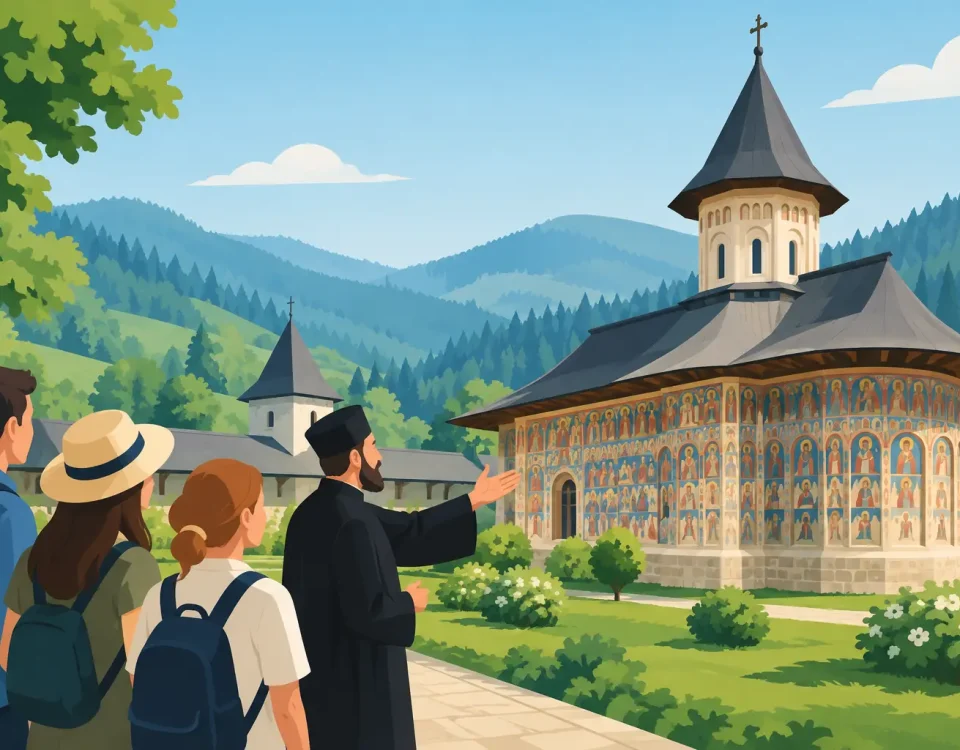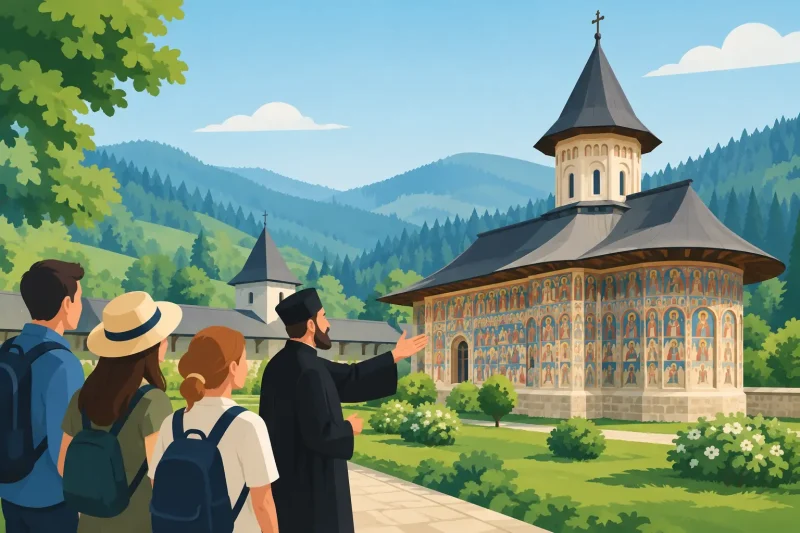

How to Visit Bucovina Monasteries in One Day
30/08/2026
Why the Blue of Voronet Still Defies Time
01/09/2026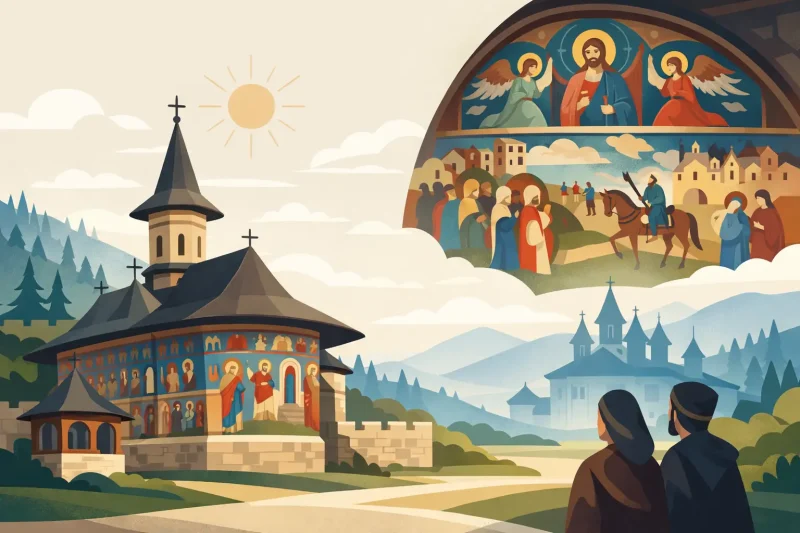
A blue angel looks down from the western wall of Voroneț Monastery, while saints, prophets, sinners, and musicians fill the space around it. This is the lasting power of the painted monasteries of Bucovina – the history of Christianity in frescoes: faith is not kept in a book or behind a museum case. It unfolds across church walls, in color, gesture, and scenes that remain immediately human more than five centuries later.
For travelers in northern Romania, these monasteries are not simply a collection of beautiful churches. They are a journey through medieval Moldavia, Orthodox spirituality, political ambition, rural tradition, and the artistic confidence of a region that chose to tell its most important stories outdoors.
Why the Painted Monasteries Matter
Most of Bucovina’s best-known painted monasteries were built during the 15th and 16th centuries, when the medieval Principality of Moldavia stood between powerful neighboring worlds. Its rulers defended their territory, funded churches, and used religious foundations to leave a visible record of gratitude, authority, and belief.
The exterior frescoes were a remarkable choice. At a time when few people could read, painted walls could teach biblical history, explain Christian ideas, honor saints, and remind a community that its local life belonged to a larger sacred story. A visitor could stand outside the church and encounter the Creation, the Last Judgment, the genealogy of Christ, hymns to the Virgin Mary, and the lives of saints.
These paintings were not created as decoration alone. They were visual theology for a living community. Their meaning remains accessible even without expert knowledge: faces show fear, hope, grief, joy, and judgment; processions move with rhythm; architecture and landscapes frame a world understood as sacred.
The churches are also among the most distinctive expressions of Orthodox art in Europe. Byzantine artistic traditions are present in their iconography, yet the compositions have a local character. The colors are bold, the figures are often unexpectedly expressive, and familiar biblical scenes are set within a Moldavian visual language shaped by the region’s landscape and history.
The History of Christianity in Bucovina’s Frescoes
Christianity reached the lands of present-day Romania through many routes and over many centuries. By the medieval period, Moldavia was firmly part of the Eastern Orthodox world, connected spiritually and artistically to Constantinople and to the Orthodox communities of the Balkans.
The monasteries of Bucovina emerged during a particularly dynamic period. Stephen the Great, prince of Moldavia from 1457 to 1504, supported many churches and monasteries after military victories and at moments of personal devotion. Putna Monastery, founded by Stephen in 1466, became his burial place and remains one of the region’s central spiritual landmarks.
His son, Petru Rareș, continued this tradition and is closely associated with the flowering of exterior mural painting in the 1530s and 1540s. During his reign, painters covered the outer walls of several churches with extensive fresco cycles. Their work gave Bucovina the visual identity travelers recognize today.
There is a historical tension in these images that makes them especially compelling. They speak of eternal salvation, but they were painted in an age of military pressure and political uncertainty. The famous Siege of Constantinople scene at Moldovița, for example, carries a message of divine protection and Christian resilience. It also reflected the anxieties of a frontier principality facing the expanding Ottoman Empire.
A Bible Painted for the Community
The frescoes offer more than a sequence of familiar biblical episodes. They organize Christian belief into a complete worldview. The eastern side of a church, closest to the altar, emphasizes the mystery of worship. The west wall often presents the Last Judgment, confronting those arriving or leaving with a vivid image of moral choice.
On other walls, the Akathist Hymn to the Virgin Mary unfolds in scenes of praise and protection. The Tree of Jesse traces Christ’s lineage through kings and prophets. Rows of saints make visible the communion between heaven and earth. Some paintings include philosophers of antiquity, suggesting that wisdom beyond the biblical world could also point toward divine truth.
The result is dense, but not distant. A good visit should allow time to look closely rather than rushing from one UNESCO sign to the next. The more slowly you observe, the more the frescoes reveal their structure, humor, and emotional detail.
The Monasteries to See in a Bucovina Itinerary
The UNESCO-listed churches are the essential starting point, though each monastery offers a different atmosphere and artistic emphasis. Their locations are spread across the region, so route planning matters as much as choosing what to see.
Voroneț Monastery is known around the world for its intense blue, often called Voroneț blue. Founded by Stephen the Great in 1488, it is especially celebrated for the monumental Last Judgment on its western wall. The scene is vast but full of intimate details: angels sound trumpets, the righteous move toward paradise, and humanity appears in all its variety.
Moldovița Monastery combines powerful exterior paintings with a setting of green hills and traditional villages. Its golden-yellow tones and the impressive Siege of Constantinople make it one of the most memorable stops for travelers interested in the connection between art and medieval history.
Humor Monastery has a warmer, red-dominant palette and a more intimate scale. Its frescoes are rich in narrative movement, while the surrounding village setting helps visitors understand that these monasteries were never isolated monuments.
Sucevița Monastery, enclosed by fortified walls, feels almost like a small medieval citadel. Its Ladder of Divine Ascent is among Bucovina’s most striking images, showing monks climbing toward heaven while demons attempt to pull them away. It is dramatic, theological, and startlingly easy to read as a story of perseverance.
Arbore Church is smaller and quieter, with elegant green frescoes and a character that rewards careful attention. Pătrăuți, the oldest of the UNESCO churches, preserves a rare and moving depiction of the Cavalcade of the Holy Cross. Together, these sites show that there is no single Bucovinian fresco style.
Putna and Dragomirna are also valuable additions to a cultural route. Putna brings visitors close to the legacy of Stephen the Great, while Dragomirna stands out for its tall, graceful proportions and distinctive architectural silhouette. Neither should be treated as an afterthought if you have more than one day in the region.
How to Experience the Painted Monasteries Well
A monastery tour can be rewarding in a single day, but the experience depends on your interests, starting point, and pace. From Suceava, a well-organized day can include several major monasteries. Yet travelers focused on photography, architecture, or religious art may prefer two days, particularly if they also want to visit local museums, artisan workshops, or villages in the Rarău area.
Dress respectfully, as these are active religious sites. Shoulders and knees should be covered, and photography rules vary by monastery. Some churches permit photos outside but restrict them indoors; a local guide can help clarify current practices and prevent uncomfortable misunderstandings.
Timing also changes the experience. Morning light can make the exterior colors appear especially vivid, while late afternoon often brings a calmer atmosphere after day-trip groups have departed. Spring through early fall is generally best for combining cultural visits with Bucovina’s countryside, though winter adds a quieter, more contemplative character.
Independent travel is possible, but distances between monasteries can be deceptive on rural roads, and public transportation rarely fits a detailed cultural schedule. For couples, families, and small private groups, a guided route with transport makes it easier to focus on the stories rather than parking, opening times, and navigation. AXA Travel can configure these days around the monuments that matter most to you, whether that means a focused UNESCO route or a wider journey including Putna, local food, and mountain scenery.
More Than a UNESCO Checklist
It is tempting to photograph Voroneț blue, check off the major monasteries, and move on. But Bucovina asks for a little more patience. Listen for the bells, notice the carved wooden gates in nearby villages, and look at how monastery walls sit against forested hills and cultivated fields. The setting is part of the meaning.
The painted monasteries have survived weather, changing borders, political upheaval, and centuries of use because they remain more than historic artifacts. They still welcome prayer, curiosity, and conversation. Give each wall a few unhurried minutes, and the frescoes will begin to feel less like distant medieval art and more like a vivid human language, spoken in color.