
Moldovita Monastery and Constantinople’s Siege
28/08/2026
How to Visit Bucovina Monasteries in One Day
30/08/2026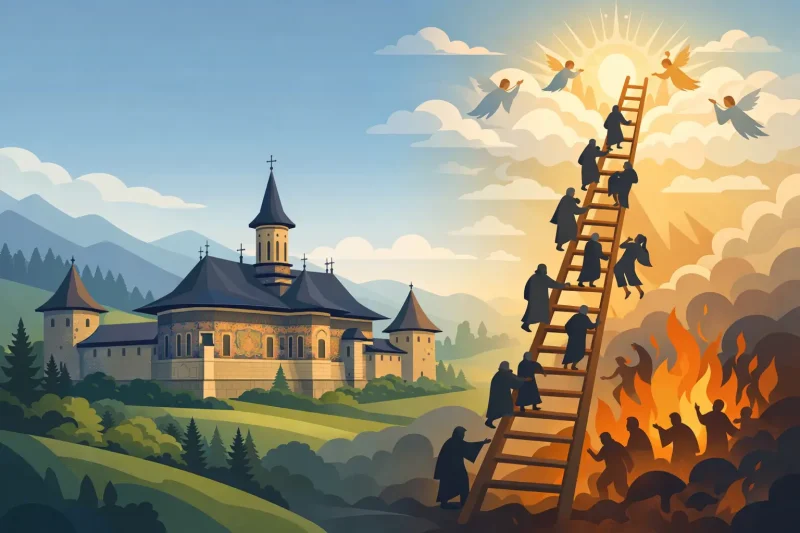
The north wall of Sucevița is not simply decorated. It tells a demanding story in color: people climbing toward heaven, angels helping them upward, and demons trying to pull them away. Sucevita Monastery – the Ladder of Divine Ascent is one of the most memorable images in Bucovina because it turns a theological idea into a scene that can be read almost like a medieval film.
For travelers following the painted monasteries of northern Romania, Sucevița offers more than a beautiful stop. It is a place where architecture, family history, monastic life, and one of Eastern Christianity’s most powerful visual teachings meet within a fortified enclosure in the green hills of Bukovina.
Sucevița Monastery and the Ladder of Divine Ascent
Sucevița Monastery was built at the end of the 16th century by the Movilă family, an influential Moldavian noble family. Its Church of the Resurrection belongs to the UNESCO-listed Churches of Moldavia, celebrated for their exterior frescoes. Unlike many European churches, where paintings remain indoors, Bucovina’s monasteries carry their stories across entire exterior walls.
At Sucevița, the frescoes are especially well preserved and richly detailed. The prevailing green gives the monastery a distinct visual character, while the broad painted surfaces invite visitors to slow down. Among the biblical scenes, saints, hymns, and images of judgment, the Ladder of Divine Ascent stands apart for its movement, emotion, and human tension.
The composition is painted on the northern exterior wall. A long ladder rises diagonally toward Christ, who waits at the top. Monks climb its rungs in a line, guided and protected by angels. Below and beside them, dark figures of demons attempt to drag climbers down. Some reach the goal. Others fall.
It is a dramatic image, but it is not intended as a simple threat. It asks a more personal question: what keeps a person on the path, and what causes them to lose balance?
The book behind the painting
The scene is based on The Ladder of Divine Ascent, a spiritual work written around the 7th century by Saint John Climacus, abbot of Saint Catherine’s Monastery on Mount Sinai. The text describes thirty steps of spiritual growth, from leaving behind destructive habits to reaching faith, hope, and love.
The thirty rungs are often understood as a reference to the thirty stages described by Saint John. Yet travelers do not need specialist knowledge of Orthodox theology to feel the painting’s meaning. The ladder is an instantly recognizable symbol of effort. Progress is possible, but it requires attention, humility, and support.
In the Sucevița fresco, salvation is not presented as automatic or distant. The climbers are active figures. They hold on, rise, struggle, and sometimes fall. That directness is one reason the scene remains so compelling for visitors from many cultural backgrounds.
How to Read the Fresco on Site
The best way to approach the Ladder of Divine Ascent is not to search for every detail at once. First, stand back and follow the direction of the ladder from lower left to upper right. You will see the entire journey: the beginning, the ascent, the attacks, and the final welcome.
Then look more closely at the figures. The demons are not accidental decorative details. They represent temptations and distractions that can interrupt a person’s inner life. The angels are equally important. Their presence suggests that the spiritual journey is not undertaken alone.
At the top, Christ receives those who have completed the ascent. Below, the fall of some climbers introduces a note of realism. The message is demanding, but not hopeless. The fresco does not mock those who fall. Instead, it presents spiritual life as an ongoing struggle requiring perseverance.
This is where Sucevița differs from a museum visit. The paintings were created for a living monastic community and for believers who learned through images. Their purpose was educational, devotional, and deeply practical. The wall became a public book for a world in which many people could not read written texts.
Why the north wall matters
The fresco’s position on the north wall is also remarkable. Northern walls are generally more exposed to weather and moisture, which makes the survival of such extensive painting especially impressive. At Sucevița, visitors can still appreciate the scale of the composition and the remarkable strength of its color.
Light changes the experience throughout the day. On a bright morning, the details can appear clearer and the green tones more vivid. On overcast days, the figures may seem more solemn, bringing out the intensity of the story. There is no wrong time to visit, but a guide can help you notice what may otherwise pass unnoticed during a short stop.
A Monastery Built Like a Refuge
The Ladder is Sucevița’s most famous image, but the monastery deserves attention as a complete ensemble. The church stands inside defensive walls with corner towers, giving the site the appearance of a protected monastic fortress. This was not only symbolic. In Moldavia’s unsettled historical landscape, religious communities and noble foundations needed security as well as beauty.
The church itself combines Moldavian architectural traditions with elements associated with the late Renaissance period. Its exterior paintings are elaborate, while the interior maintains the more intimate, candlelit atmosphere of an Orthodox place of worship. The shift from the bright courtyard to the church interior is part of the visit: outside, stories unfold across walls; inside, sacred space becomes quieter and more concentrated.
The monastery museum, when open, adds useful context through religious objects, manuscripts, embroidery, and historical artifacts. It is worth allowing time for this small collection, particularly for travelers interested in the craftsmanship and patronage behind Bukovina’s religious heritage.
Planning a Visit to Sucevița
Sucevița lies in northern Bucovina, near the town of Rădăuți, approximately 40 miles from Suceava. The route passes through villages, rolling farmland, and wooded foothills, making the journey part of the experience rather than merely a transfer.
For independent travelers, a visit requires careful timing. Public transportation can be limited, connections are not always convenient, and the monasteries are spread across a wide rural area. A rental car offers flexibility, but roads, parking, opening arrangements, and the number of sites you hope to include will shape the day.
A private guided tour is often the easier choice if you want to combine Sucevita with other important monuments without rushing. Depending on your pace, Sucevita can be paired with Putna Monastery and the pottery village of Marginea or included in a longer route with Dragomirna, Arbore and Patrauti. Trying to visit several painted monasteries in one day is only possible at a very fast pace and usually leaves little time to absorb the details that make each place unique.
When visiting, dress respectfully. Shoulders and knees should be covered, and women may be asked to wear a head covering in certain areas. Photography rules can vary between the courtyard, church interior, and museum, so it is best to ask before taking pictures. The monastery remains an active religious community, not a themed attraction.
Making Space for the Story
Sucevița rewards travelers who give it more than ten minutes. Walk the exterior walls slowly. Notice the contrast between the grand theological compositions and the fine decorative borders. Step back from the Ladder, then return to inspect individual faces and gestures. The story becomes more human with every look.
For guests traveling through Bucovina, AXA Travel can organise a cultural route that places Sucevița in its proper regional context, with comfortable transport and local guidance from Suceava. The goal is not simply to check UNESCO monuments off an itinerary, but to understand why each monastery was built, painted, and remembered.
Before leaving the north wall, take one final look at the ladder. Whether viewed as a religious teaching, a work of art, or a universal image of human effort, it leaves a quiet invitation: travel slowly enough to let a place ask something of you.