
The Judgement Day at Voronet, Sistine Chapel of the East
22/08/2026
Sucevita Monastery – The Ladder of Divine Ascent
29/08/2026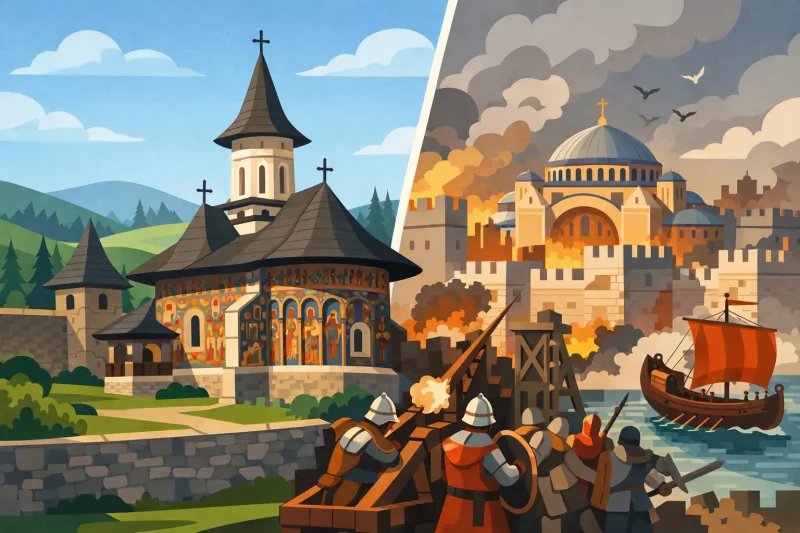
Few images on the painted churches of Bucovina hold a traveler’s attention as firmly as the scene often described as Moldovita Monastery – the Siege of Constantinople, the power of faith. On the monastery’s exterior walls, a vast painted army advances toward the great Christian city. Ships cross dark water, defenders stand on the ramparts, and above the struggle is a message that reaches beyond military history: protection, prayer, and faith can shape how a community understands danger.
For visitors arriving in Bucovina, this is not simply an impressive fresco to photograph. It is one of the most revealing images of the 16th-century Moldavian world, painted at a time when the region itself lived close to powerful borders and uncertain alliances. Moldovița invites us to look carefully, ask questions, and see a monastery not as an isolated monument, but as a place where art, politics, devotion, and local identity met.
A monastery created for color, story, and memory
Moldovița Monastery stands in the gentle landscape of northern Romania, near the village of Vatra Moldoviței. The present church was built in 1532 by Prince Petru Rareș, son of Stephen the Great, on the site of an earlier monastic foundation. Its exterior paintings were completed a few years later, in 1537, and they remain among the defining artistic achievements of Bucovina.
The church is known for its luminous yellow background, a color that changes with the weather and the hour of day. In morning light, the walls can seem warm and golden; under cloud cover, the painted scenes appear quieter, almost solemn. That changing atmosphere is part of the experience. The frescoes were never intended to be viewed in a museum-like white room. They belong to the mountain air, the seasons, the sound of bells, and the patient rhythm of a working monastery.
The paintings also had a practical purpose. They made biblical and historical teachings visible to a broad community, including people who could not read. Every wall became a visual lesson. Saints, angels, hymns, prophets, judgment scenes, and military episodes formed a painted theology that could be understood through attention and guidance.
Moldovita Monastery’s Siege of Constantinople fresco
The fresco traditionally called the Siege of Constantinople appears on the southern exterior wall. Its source is the story of Constantinople’s deliverance in 626, when the Byzantine capital was threatened by Avar and Persian forces. According to Orthodox tradition, the city was saved through the intercession of the Virgin Mary, who was regarded as its protector.
The historical event should not be confused with the Ottoman conquest of Constantinople in 1453. That later fall was still a recent and deeply felt memory when Moldovița’s frescoes were painted. Yet the image at Moldovița refers to the earlier siege, transforming it into a spiritual and symbolic scene rather than a literal historical record.
The composition is full of movement. Attackers gather outside the walls. Boats and armed figures bring the danger close to the city. Within and above the city, the defenders are linked to the sacred protection of the Mother of God. The message is not that prayer replaces courage, preparation, or human action. Rather, the fresco presents a world in which courage and collective faith belong together.
For Petru Rareș and his contemporaries, this subject carried urgent meaning. Moldavia was a smaller principality positioned between great powers, including the Ottoman Empire, Poland, Russia and Hungary. The painted defense of Constantinople offered more than a memory of Byzantium. It spoke to a community trying to preserve its faith, autonomy, and cultural continuity.
The power of faith, painted without simplification
It is tempting to read the fresco as a simple triumph: believers pray, enemies retreat, and the city is saved. But the lasting force of the image comes from its tension. The walls are under threat. The sea is crowded. The city’s safety is not taken for granted.
Faith, in this context, is not passive optimism. It is a form of endurance. It gives people a language for facing uncertainty and a sense of belonging when political circumstances are unstable. This is why the scene still feels immediate for many visitors. Even without sharing the religious beliefs expressed in the painting, travelers can recognize the human need to protect a home, a community, and a way of life.
The fresco also reflects the Byzantine inheritance cherished in medieval Moldavia. After Constantinople fell in 1453, Orthodox rulers and church communities across Eastern Europe continued to see themselves as guardians of a tradition that had once centered on the imperial city. At Moldovița, Constantinople is both a real place and an idea: the spiritual center under attack, the city that must be remembered and defended.
This makes the fresco particularly moving when viewed in Bucovina. The painted church does not imitate distant Byzantium. It translates that inheritance into a local visual language, with vivid colors, expressive faces, detailed architecture, and a bold narrative scale. The result is unmistakably Moldavian.
How to look at the fresco on your visit
A good visit to Moldovița is slower than many travelers expect. From a distance, the Siege of Constantinople appears as a dramatic historical panorama. Step closer, and individual scenes emerge: the city walls, the vessels, the soldiers, the gestures of alarm and resistance. Allow time for both views.
Start by taking in the scale of the southern wall. Then look for the relationship between the city and the figures associated with divine protection. A local guide can help distinguish the historical source of the scene from the 16th-century concerns that shaped its final form. That context matters, because the fresco becomes far richer once visitors understand that it is not a documentary image of a battle.
Photography conditions can vary with sun, restoration needs, and monastery rules, so it is wise to approach the site respectfully and follow guidance on the day. The exterior paintings are precious and vulnerable. They have survived nearly five centuries because generations of people have treated them as living heritage rather than scenery.
Inside the church, the atmosphere changes. The interior is more intimate, with iconographic scenes designed for worship. Together, the inner and outer paintings create a complete experience: the church gathers the faithful within, while its exterior walls speak to the wider world outside.
Making Moldovița part of a Bucovina route
Moldovița is best experienced as part of a thoughtful route through the painted monasteries, rather than as a rushed stop between long drives. Its location works well with nearby Sucevița Monastery, famous for its green frescoes and the Ladder of Divine Ascent, and with the village area around Vama and Câmpulung Moldovenesc. Depending on your schedule, the journey can also include a ride on the Moldovița Mocănița steam train or time in the Rarău Mountains.
For a first visit, a full-day circuit from Suceava allows enough time to understand why each monastery has its own identity. Voroneț is celebrated for its blue and Last Judgment scene; Humor is known for its red tones and narrative frescoes; Moldovița stands apart through its warm yellow walls and its powerful rendering of Constantinople under siege.
Private travel is especially useful for this region because the sites are spread across rural valleys and small towns. It gives couples, families, and small groups room to pause where the light is best, adjust the pace, and spend longer at the monuments that resonate most. AXA Travel can organise a guided Bucovina itinerary with comfortable transport and local interpretation, whether your interest is UNESCO heritage, Orthodox art, village traditions, or a wider cultural journey through northern Romania.
Moldovița rewards the traveler who stays with the image for a few extra minutes. Beneath its golden walls, the siege of a distant city becomes a story about the resilience of a region – and about the enduring human hope that what is loved can be protected.