
Bucovina Versus Maramures Itinerary: Which One?
20/08/2026
Moldovita Monastery and Constantinople’s Siege
28/08/2026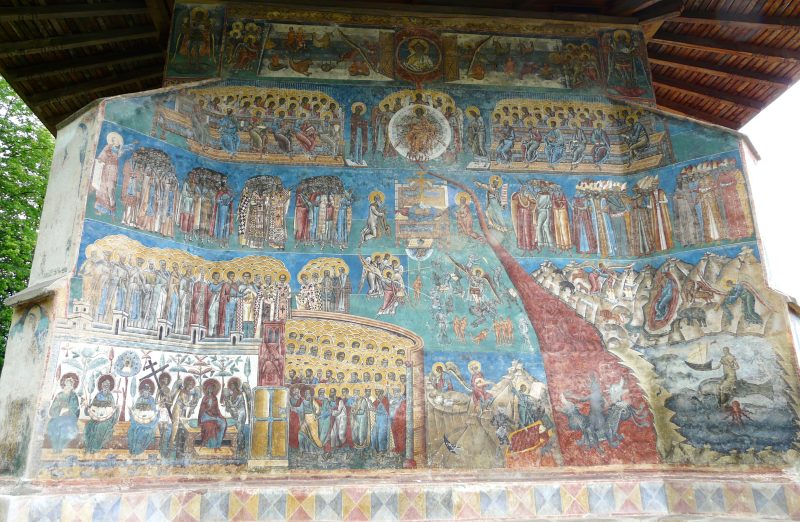
Travelers who search for “the judgement day – Voronet, the sistine chapel of orient” are usually looking for one of Bucovina’s most powerful artistic encounters: the exterior fresco of the Last Judgment at Voronet Monastery. The phrase is commonly intended to refer to the “Sistine Chapel of the East” a name earned by the monastery’s extraordinary painted walls, not by its size, but by the force of its visual storytelling.
On the western wall of Voronet’s church, the Last Judgment is not a small scene to admire from a distance. It is an entire theology of color, movement, warning, hope, and local imagination, painted for people who learned as much from images as from books. For visitors to Bucovina, standing before it is often the moment when the region’s painted monasteries become more than a list of UNESCO sites.
The Judgement Day at Voronet: a wall that speaks
Voronet Monastery was founded in 1488 by Stephen the Great, Moldova’s ruler and one of the defining historical figures of medieval Moldavia. The church was built quickly, in a little over three months according to tradition, following a victory over the Ottoman Empire. Its famous exterior paintings were added later, in 1547, during the leadership of Metropolitan Grigorie Roșca.
The western facade contains the Last Judgment, a monumental composition that unfolds across the surface of the church. Christ appears as judge at the center of the upper register, surrounded by angels, apostles, saints, and the instruments of the Passion. Below, the dead rise from graves, the righteous move toward paradise, and sinners are carried toward punishment.
Yet the painting does not feel distant or abstract. It is crowded with human faces, expressive gestures, musical angels, kings, bishops, ordinary souls, animals, and fantastic creatures. The scene was designed to be read slowly, almost like a visual journey. A local guide can help visitors notice details that are easy to miss at first glance: the river of fire, the weighing of souls, the prepared throne, or the figures representing different peoples of the world.
The message is direct, but not only severe. The fresco holds together justice and mercy, fear and faith, the end of time and the promise of salvation. That emotional range is one reason it still affects modern visitors, including those who do not come to Voronet primarily for religious reasons.
Why Voronet is called the Sistine Chapel of the East
The comparison with the Sistine Chapel is useful as a starting point, but it should not flatten Voronet into a Romanian version of an Italian monument. These are very different places, born from different artistic traditions and religious worlds.
Voronet belongs to the Moldavian tradition of painted monasteries, where biblical scenes cover the exterior walls of churches. The paintings were made to endure the changing seasons of northern Romania and to communicate Christian teaching to a broad community. Rather than being hidden indoors, the theology is visible from the courtyard, beneath open skies and among the wooded hills of Bucovina.
The nickname “Sistine Chapel of the East” recognizes the ambition and artistic achievement of the frescoes. It also reflects the memorable impact of the Last Judgment composition. Still, Voronet’s significance lies in its own language: Byzantine-inspired, Moldavian in character, and deeply connected to the history of this borderland region.
Its most celebrated feature is Voronet blue, a rich and luminous shade that has survived nearly five centuries. The exact historic recipe remains a subject of fascination. Weather, light, moisture, and restoration history all influence what visitors see today, so the blue may look softer on an overcast morning and vivid under a clear summer sky. It is not simply a color to photograph. It is part of the atmosphere that gives the monastery its unmistakable presence.
What to look for on the western facade
The best way to experience the Last Judgment is to give it time. Start at the upper portion of the wall and allow your eyes to move downward through the composition. Notice the balance between order and motion: heavenly figures are arranged with calm dignity, while the lower scenes carry tension and urgency.
Look for the angels sounding trumpets to awaken the dead. Observe the souls emerging from earth and sea, a reminder that no place is beyond divine knowledge. Follow the river of fire as it descends from the throne, and then turn your attention to the garden of paradise, represented with warmth and abundance.
Many visitors are surprised by how immediate the fresco feels. It is medieval art, but it does not feel silent. Every section appears to be speaking, singing, pleading, judging, or moving toward a destination.
A practical visit to Voronet Monastery
Voronet is located near the town of Gura Humorului, approximately 40km from Suceava. It is one of the most accessible painted monasteries in Bucovina, but it deserves more than a quick stop between destinations. Plan enough time to walk through the grounds, study the exterior paintings, enter the church respectfully, and absorb the quieter rhythm of the place.
Mornings are often ideal, especially for travelers who prefer lower light and fewer visitors. In the warmer months, Voroneț Monastery can be comfortably included in a day tour of Bucovina painted monasteries, along with Humor, Moldovița, and Sucevița Monastery. A more relaxed itinerary can combine Voroneț with Gura Humorului, a traditional meal, and time spent in the surrounding countryside.
Dress modestly when visiting active religious sites. Shoulders and knees should be covered, and visitors should follow any photography rules posted at the monastery. Interior spaces are smaller and more intimate than many American travelers expect, so patience and a quiet approach make the visit better for everyone.
Private transportation is particularly helpful in Bucovina. The monasteries are spread across valleys and villages, and public connections do not always align with a traveler’s available time. With a local driver-guide offered by AXA Travel, it becomes easier to understand the landscape between stops: the forests, mountain passes, rural homes, and historic routes that give each monastery its context.
Placing Voronet within a Bucovina itinerary
Voronet is often the first painted monastery visitors see, but it should not be the only one. Its drama becomes even clearer when compared with the distinct character of nearby sites.
Humor Monastery is known for its warm red tones and lively narrative frescoes. Moldovita presents a magnificent Siege of Constantinople scene and a broad setting among hills. Sucevita impresses with its scale and the famous Ladder of Divine Ascent, while Arbore offers a more intimate church with elegant exterior painting. Patrauti with its compact form and peaceful. Putna adds the historical presence of Stephen the Great, and Dragomirna reveals a different architectural mood altogether.
There is a trade-off between seeing many monasteries and seeing them well. A one-day route can introduce the essential highlights, particularly for travelers based in Suceava or Gura Humorului. A two- or three-day itinerary creates room for unhurried visits, village landscapes, craft workshops, local food, and perhaps a mountain experience in the Rarau area.
For guests who want cultural context without managing roads, parking, timing, and language logistics, AXA Travel can organize a private or small-group Bucovina route with licensed local guidance and comfortable transport. The itinerary can focus entirely on the painted monasteries or combine Voronet with heritage sites, nature, and traditional experiences according to the season and the pace of the group.
The painting is best understood in place
Books and photographs can introduce the Last Judgment at Voronet, but they cannot recreate its setting. The wall is outside. Wind moves through the trees, bells may be heard from the monastery, and the blue shifts as clouds pass over the Bucovina sky. The fresco is inseparable from that experience.
When you stand before it, resist the urge to see only the famous blue or to take one quick photograph and move on. Let the scene unfold. Voronet asks for attention, and it rewards it with a story that has been visible to travelers, pilgrims, and local communities for nearly five hundred years.